The Myth That Every Useful Container Needs a New Purpose
A simple container decision method helps you keep what fits a real task, release what does not, and avoid turning cupboards into storage for storage.
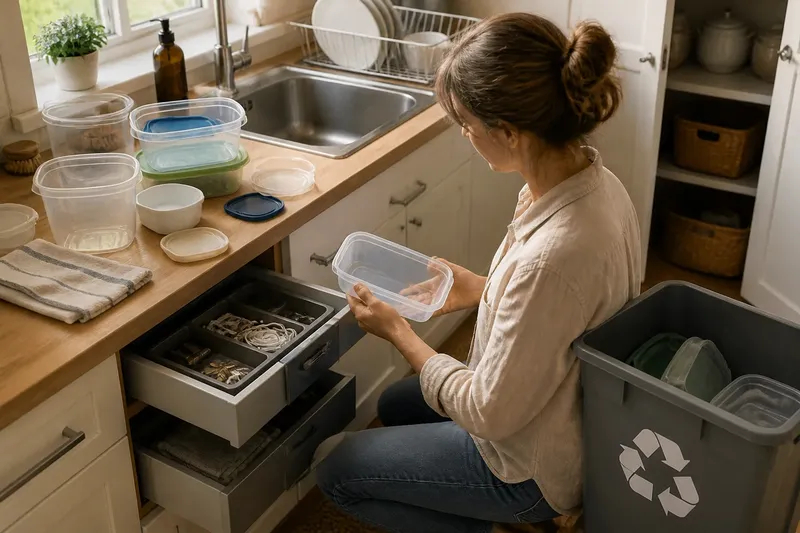
A clean takeout tub sits beside the sink while you wash dishes, and your hand pauses over the recycling bin. It could hold screws, freeze soup, or keep a drawer organized. The trouble is that “could” gives nearly every container a permanent place in the house. A useful container decision method starts with a narrower question: does this one fit a real task you expect to do?
Potential is not a household assignment
Containers invite imagined futures. A sturdy tub might become a paint tray, a jar might corral buttons, and a small tin might organize travel supplies. Each possibility sounds modest. Together, they can turn cupboards, closets, and desk drawers into a waiting room for objects that have not been asked to do anything.
Reuse is most useful when it connects an existing object to a need. Without that connection, keeping a container does not save effort so much as postpone a decision. The object still needs a place, and later you still need to decide whether to use it, store it, or let it go.
This does not mean every container must earn its keep immediately. A known seasonal use or a recurring household task can justify setting one aside. The distinction is between a plan you can describe and a possibility that depends on eventually becoming a different, more convenient container.
Start with the task, not the container
Turn the usual question around. Instead of asking what an empty container might hold, name the task that currently lacks a suitable place or tool. Perhaps loose charging cables need a home, or you regularly carry snacks to work. If no task comes to mind, that is useful information: the container has no current assignment.
A specific purpose should be concrete enough to picture in its actual setting. “Store craft supplies” leaves room for an expanding collection of lids, boxes, and tins. “Hold the embroidery floss in the sewing drawer” identifies both the contents and the location, making it easier to judge whether the container belongs there.
Say you have a clean plastic tub from prepared food and a drawer where spare batteries keep sliding behind other items. You decide the tub is meant to hold those batteries, place it in the drawer, and expect to see whether its shape and height make them easier to find. If the lid has no purpose and the tub crowds the drawer, the decision can be revised rather than defended as a good reuse idea.
Fit includes the place and the routine
Physical fit is only part of the test. A container can be the right size for an object but awkward for the way you reach, clean, or use that object. A deep, narrow jar may hold cooking utensils but make the smaller ones hard to retrieve. A box that fits a shelf may block access to whatever sits behind it.
Think about how often the contents move in and out. For something used daily, an opening that is easy to reach may matter more than a lid that looks tidy. For something stored out of sight, a secure closure or a clear label may be more helpful. The best choice is shaped by the task, not by a general preference for neat-looking containers.
Location matters, too. A container intended for the entryway has to fit the shelf, bench, or hook area where it will live. If its assigned home is already occupied, decide what will move before keeping the container. Otherwise, the new arrangement quietly transfers the clutter rather than solving it.
Condition sets practical limits
Inspect the container for cracks, sharp edges, warped surfaces, lingering odors, and lids that no longer meet their rims. A damaged piece may still be usable for a low-stakes purpose, but it should not be treated as suitable for every task. A cracked tub is a poor choice for anything that needs to stay contained; a stained container may be fine for workshop bits if it is otherwise sound and clean.
Consider the material in relation to its proposed use. Some containers are suitable for food storage, while others are not; some can be used in a freezer or dishwasher, while others may warp or deteriorate. Check the label or manufacturer’s instructions when use depends on those details, and follow local rules for disposal where they apply.
Cleaning is part of the assignment. If a container has narrow grooves, an awkward lid, or a smell that survives ordinary washing, ask whether maintaining it will be worth the use it provides. An item that is technically reusable but unpleasant to clean can become another object the household avoids.
Keep a bounded reserve for real needs
Some homes have recurring reasons to keep a small selection of spare containers. They may be useful for packed lunches, organizing a specific craft, or returning food to a neighbor. A reserve makes sense when you can name the job and identify where the spare pieces will live.
Give that reserve a defined home, such as one shelf or one drawer, and let the available space set its limit. When the space is full, choose whether a new container replaces one already there or is released. This keeps the boundary visible without requiring a household inventory or a complicated rule about how many pieces are acceptable.
Keep related parts together when the parts are useful together. A lid with no matching container is not automatically a spare, and a container whose lid is missing should not be kept solely because the lid might turn up someday. If a lid has a separate, specific use, it can be judged on that use; otherwise, the pairing problem is a clear reason to let one or both pieces go.
How do I decide whether a container is worth keeping?
What counts as a specific planned use?
Name what will go inside, where the container will live, and how you expect to use it. “Hold the spare keys in the hall drawer” is specific; “might be useful for organizing” is not.
Should I keep containers for occasional needs?
Yes, if the need is recognizable and the container has a defined place. A spare used for a recurring holiday or a known repair task does not need daily service, but it should not occupy space reserved for an imagined emergency.
What if I cannot tell whether the material is suitable?
Do not assign it a use that depends on uncertain properties, especially for food or heat. Look for its label or manufacturer’s instructions, or choose a different container whose suitability is clear.
How can I release containers without regretting it?
First separate any item with a real planned use from those kept only for possibility. If a container has no task, no suitable condition, or no place to live, letting it go is a decision about that object today, not a prediction about every future need.
Let the arrangement answer the question
When a container seems promising but its fit is uncertain, make the proposed use visible before it earns a permanent place. Put it where it would live and add the intended contents if they are already available. This is not a trial of whether the container is universally useful; it is a check that this particular arrangement makes the task easier to carry out.
If the arrangement requires moving several other things, hiding the container behind daily supplies, or remembering an elaborate workaround, the fit is poor. Choose a simpler option, use an existing container already assigned to that task, or leave the task without a dedicated container. Not every household function improves when it gets its own box.
For a still-uncertain but plausible use, a short note can help: write the intended task on a scrap of paper and place it with the container. If the note no longer describes a need when you next encounter it, release the container. The note is a prompt to make a decision, not a reservation system for every object that might someday be convenient.
The useful-container decision method is less about predicting what you might need than noticing what your home already asks you to do. A container that fits a task, its location, and its condition can earn a place. One that fits only a story about its future can leave without an apology.