Glass Jar or Paper Bag for Storing Dry Goods?
Glass jar or paper bag for storing dry goods? Match visibility, easy handling, and cupboard space to the way you shop, cook, and put supplies away.
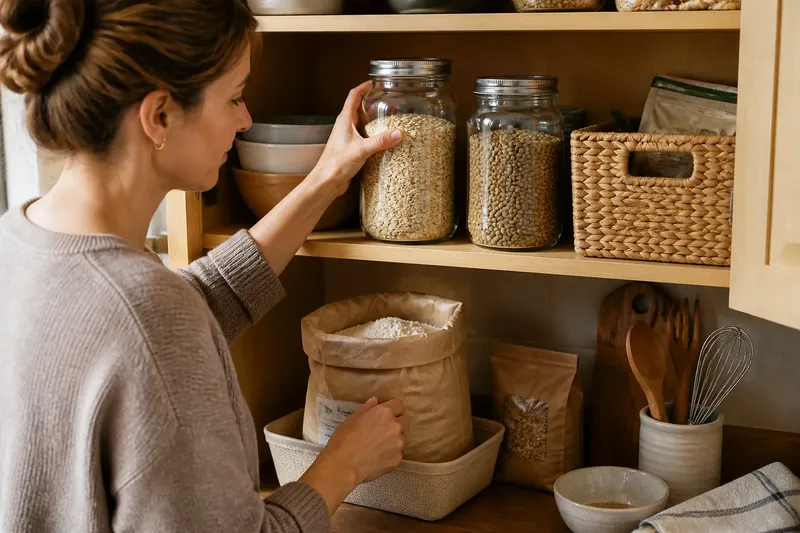
At the kitchen counter, a half-open paper bag of oats leans against a glass jar of lentils, while a second jar blocks the shelf where the flour ought to go. Choosing a glass jar or paper bag for storing dry goods is less a contest between materials than a question of how each fits the cupboard routine around it.
Say Mara, an entirely invented home cook, brings home oats, dried beans, and flour from a neighborhood market. Her cupboard is shallow, she cooks from a short list of familiar staples, and she wants to reuse containers she already owns. She sorts the supplies by how often she reaches for them, then gives each material a job rather than imposing one rule on every item.
Start with the cupboard routine
Mara’s first decision is not what looks tidiest on the counter. It is where each item will live and what she needs to do when she reaches for it. A jar can make contents easy to see, but it takes up a stable block of shelf space. A folded paper bag can be tucked into a narrow gap, but it needs a reliable way to stay closed.
She notices that the oats are used often and usually measured directly into a bowl. The beans are used less often and tend to remain in the cupboard for a while. The flour is opened during baking, when a bag that folds back neatly may be easier to handle than a jar with a narrow opening.
These are not universal rules about oats, beans, or flour. They are observations about Mara’s habits: what she reaches for, how she serves it, and how much room remains after groceries are put away. Another kitchen may call for different assignments.
Glass makes contents easy to identify
A clear glass jar lets Mara see how much is left without opening it. That helps when she is deciding whether to add oats to a shopping note or use the remainder for breakfast. It also makes a forgotten ingredient less likely to disappear behind an opaque package, provided the jar stays where she can see it.
Visibility has a counterpart: the jar must be easy to distinguish from the others. Mara chooses a wide-mouth jar already in her cupboard for the oats, rather than transferring them into a small decorative bottle. The wider opening lets her use a measuring cup without shaking the jar or chasing flakes around its rim.
Glass is rigid, so a jar remains open and upright while Mara scoops. It can also be awkward to lift if it is large or stored high, and the cupboard shelf needs room for its footprint. She keeps the jar on a reachable shelf rather than treating a heavy container as a display object.
For the lentils, she uses another existing jar because their shape and color are easy to recognize through the glass. She turns the original label outward beside it, so the jar’s contents are not mistaken for another similar-looking staple. A small piece of removable tape can carry a name if the packaging is no longer nearby.
Paper bags fold into a changing shelf
Paper bags are light and easy to move around. When Mara brings home flour in a paper package, she can fold the top down after use and place the bag in a bin on the lower shelf. The bag occupies the space of its contents rather than requiring an empty ring of room around a rigid container.
That flexibility is useful when packages vary in size or when the shelf holds items that come and go. It is less convenient if the folded top springs open, the bag tips over, or flour dust collects along the fold. Mara folds the top away from her and slides the bag into a small, open-sided bin she already uses for baking supplies. The bin keeps the package upright without making her decant the flour.
A paper package can also carry useful information: the ingredient name, cooking notes, or instructions from the seller. Mara leaves that label visible. If she transfers a dry good into a jar, she can keep the original package or copy the relevant information onto a removable label rather than relying on memory.
Paper is not automatically the better choice for every cupboard. A bag that is difficult to reseal, gets handled with damp hands, or sits where it can be crushed may be a poor fit. Mara checks how the package behaves in its actual place before deciding whether to keep using it or move the contents.
Match the opening to the way you cook
Handling often settles a close decision. A jar is convenient when a spoon or measuring cup fits through its opening and the container can be lifted comfortably. A bag can be easier to pour from when its top opens broadly, but it may need one hand to hold the sides apart.
Mara tests each choice in the ordinary sense of trying the motion as part of putting groceries away, not as a formal performance claim. She lifts the oat jar from the shelf and checks that she can reach in without scraping her knuckles. She opens the flour bag over the mixing bowl and sees that its folded top is easy to manage. Those familiar movements matter more than a matching set.
Serving tools can change the answer. A scoop with a broad handle may be easy to store beside a jar but awkward inside a narrow-necked bottle. A bag may pour cleanly into a bowl yet spill if its corners are soft. Mara keeps the scoop with the oats and uses the measuring cup for flour, so each package suits the tool she already reaches for.
Use a simple assignment rather than one rule
For her cupboard, Mara settles on the glass jar for oats, the glass jar for lentils, and the original paper bag for flour. This arrangement reflects three different uses: frequent scooping, visible storage, and a package that folds into the baking bin. It does not mean that glass is best for grains or that flour belongs in paper.
She puts the often-used jar at the front, the lentils beside it, and the flour bin on the lower shelf. The result is observable in an ordinary way: when she opens the cupboard, she can identify the staples, reach the oats without moving another package, and take out the flour without shifting a jar. If the arrangement becomes inconvenient, she can change one assignment instead of replacing everything.
For someone with less shelf space, a lighter jar or a paper package in a bin might make more sense. For someone who wants to check remaining quantities at a glance, a clear jar may help. For someone who buys supplies in varied packages or moves them often, flexible bags may be easier to place. The useful comparison is between the material and the task, not between abstract claims that one is always neater.
Questions that help choose a container?
Does a glass jar keep dry goods fresh?
A jar’s usefulness depends on its closure and on the condition of the dry good, not just on the glass. Check the package guidance and use a clean, dry container with a lid that closes properly; keep the jar in a suitable cupboard away from moisture.
Can I keep dry goods in the paper bag they came in?
Often, if the bag closes in a way that suits the cupboard and the contents stay dry and protected from spills. Fold the top securely or place the bag in a reusable bin if it tends to slump or open.
Which is easier to label?
Both can be labeled, though a paper package may already have its name and product details printed on it. A glass jar can take removable tape or a tag, which is handy if you reuse it for different contents.
Should I transfer everything into matching jars?
No. A coordinated shelf is not much help if its containers are awkward to lift, hard to fill, or poorly suited to the space. Keep the containers that make everyday access easier and reuse the original packaging when it works.
Let the shelf decide what stays
After using the arrangement for a while, Mara checks for practical signs rather than judging the cupboard by appearance alone. She looks for a lid that is troublesome to remove, a bag that will not stay folded, a container that crowds neighboring items, or a staple that is hard to identify. Each sign points to a particular adjustment.
If the oats jar is awkward to lift, she can move it lower or use a smaller jar she already owns. If the flour bag keeps opening, she can put it in the baking bin or choose a reusable container with an opening that works for her measuring cup. If the lentils are difficult to identify, a clearer label may solve the problem without changing their container.
When deciding between a glass jar or paper bag for storing dry goods, begin with visibility, handling, and the available shelf space, then consider the motions you repeat while cooking. Mara’s arrangement works because each package has a place and a purpose. The most useful container is the one that lets you put the food away and reach it again without creating a new cupboard chore.